Tuesday, April 19, 2011

Jon Bon Jovi on Technological Change


...well, sort of.

In a recent article, Jon Bon Jovi lashed out at Steve Jobs for ruining the music industry. Basically, the move to a new technology has so changed the process of "record buying" so as to have killed the music industry and changed the culture of music appreciation:

Kids today have missed the whole experience of putting the headphones on, turning it up to 10, holding the jacket, closing their eyes and getting lost in an album.
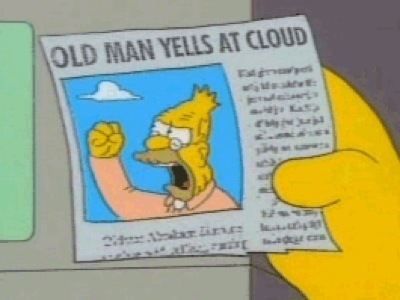
Next thing you know Mr. Bon Jovi will be complaining about the clothes young people are wearing these days, shaking his fist at clouds, and telling those kids to "Stay off my lawn!"


Monday, April 18, 2011

The First Step Towards Taxing Religion?

I'm a little late to the table on learning about this, but Romania has introduced a new tax, adding "witch" to the existing list of labor codes:

Those charging clients for tarot readings, curses, and blessings must now pay a 16 percent income tax and make contributions to health and pension programs.
As has happened with other previously-considered "cultural groups," as they enter or adapt to market institutions they find themselves subject to conditions that face all market participants.

Witches adapted to a free market quickly. Emerging businesses sought their aide, creating a growing clientele for witchcraft. In 1997, there was an attempt to form a “witches’ union,” in part to counter the claims of dozens of upstart witches that they were descendants of Mama Omida. In 1999, there was even a plan to build a thirty-five room “national center of witchcraft” on the outskirts of Bucharest. However, the witches appear to have become victims of their own success. The idea of taxing witchcraft was first put forward in 2001.


HT: @acrofish

Monday, April 11, 2011

Police versus Education, War versus Hospitals


The 2011 World Development Report has been released. Here's a bit form its web site:

More than 1.5 billion people live in countries affected by violent conflict.
The World Development Report 2011: Conflict, Security, and Development examines the changing nature of violence in the 21st century, and underlines the negative impact of repeated cycles of violence on a country or region’s development prospects. Preventing violence and building peaceful states that respond to the aspirations of their citizens requires strong leadership and concerted national and international efforts. The Report is based on new research, case studies and extensive consultations with leaders and development practitioners throughout the world.
Some are arguing that this report represents a major change in the way the World Bank is advocating aid resources be allocated. Indeed, it appears that the Bank is advocating resources be used in building stable governments, justice and police... rather than emphasizing education and health. From the BBC:
The report says if there is not a major refocusing of aid in this direction, then other targets on poverty, health and education will not be reached.

There is far more spent on alleviating the effects of conflict than preventing it from breaking out, and conflicts tend to be repeated.

Wednesday, January 26, 2011

The "Heart of Economics"

I'm currently teaching a course on "the economics of social problems." It can be a tricky course because I need to communicate to students that, for example, poverty is about more than low income. Its also about opportunities, happiness or well-being, cognitive adaptations (i.e., beliefs) and more.

With this in mind, I found today's piece in the NY Times by Ed Glaeser interesting. He writes:
Teachers of first-year graduate courses in economic theory, like me, often begin by discussing the assumption that individuals can rank their preferred outcomes. We then propose a measure — a ranking mechanism called a utility function — that follows people’s preferences.

But then we turn to welfare, and that’s where we make our great leap.

Improvements in welfare occur when there are improvements in utility, and those occur only when an individual gets an option that wasn’t previously available. We typically prove that someone’s welfare has increased when the person has an increased set of choices.

When we make that assumption (which is hotly contested by some people, especially psychologists), we essentially assume that the fundamental objective of public policy is to increase freedom of choice.

Economists’ fondness for freedom rarely implies any particular policy program. A fondness for freedom is perfectly compatible with favoring redistribution, which can be seen as increasing one person’s choices at the expense of the choices of another, or with Keynesianism and its emphasis on anticyclical public spending.

Thursday, December 9, 2010

Lectures from the 2010 Nobel Prize in Economic Sciences

From Mark Thoma at Economist's View, here are links to the Nobel lectures by Peter Diamond, Dale Mortenson, and Christopher Pissarides.

Taxation for Cultural Change


Now that the month of Movember is over, I thought I would post some interesting evidence on the use of taxation to achieve cultural change.

In 1705, Peter I of Russia implemented a tax on beards: Individuals who wore beards were required to pay a levy and, as evidence of having paid the tax, had to wear
a copper or silver token with a Russian Eagle on one side and on the other, the lower part of a face with nose, mouth, whiskers, and beard. It was inscribed with two phrases: "the beard tax has been taken" and "the beard is a superfluous burden".
Whatever you may think of beards and mustaches as aesthetic facial hair, Peter had his reasons. He was particularly interested in increasing trade and political interactions with the rest of Europe, much of whom viewed Russia as archaic. To try and change this perception:

Peter ordered his noblemen to wear fashionable Western clothes instead of their archaic long costumes. To add insult to injury, Peter personally cut off the beards of his noblemen. All men except the peasants and priests had to pay Peter's yearly beard tax and wear a medal proclaiming, "Beards are a ridiculous ornament."