Showing posts with label markets. Show all posts

Tuesday, April 19, 2011

Jon Bon Jovi on Technological Change


...well, sort of.

In a recent article, Jon Bon Jovi lashed out at Steve Jobs for ruining the music industry. Basically, the move to a new technology has so changed the process of "record buying" so as to have killed the music industry and changed the culture of music appreciation:

Kids today have missed the whole experience of putting the headphones on, turning it up to 10, holding the jacket, closing their eyes and getting lost in an album.
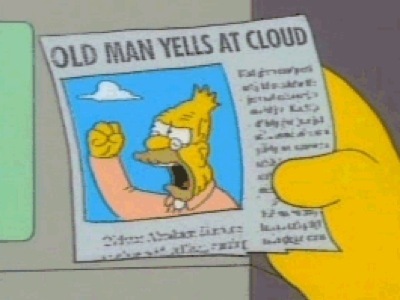
Next thing you know Mr. Bon Jovi will be complaining about the clothes young people are wearing these days, shaking his fist at clouds, and telling those kids to "Stay off my lawn!"


Monday, April 18, 2011

The First Step Towards Taxing Religion?

I'm a little late to the table on learning about this, but Romania has introduced a new tax, adding "witch" to the existing list of labor codes:

Those charging clients for tarot readings, curses, and blessings must now pay a 16 percent income tax and make contributions to health and pension programs.
As has happened with other previously-considered "cultural groups," as they enter or adapt to market institutions they find themselves subject to conditions that face all market participants.

Witches adapted to a free market quickly. Emerging businesses sought their aide, creating a growing clientele for witchcraft. In 1997, there was an attempt to form a “witches’ union,” in part to counter the claims of dozens of upstart witches that they were descendants of Mama Omida. In 1999, there was even a plan to build a thirty-five room “national center of witchcraft” on the outskirts of Bucharest. However, the witches appear to have become victims of their own success. The idea of taxing witchcraft was first put forward in 2001.


HT: @acrofish

Wednesday, October 27, 2010

Economics and Art History


I'm currently reading Sassoon's Becoming Mona Lisa, a book about how Leonado Da Vinci's most famous painting became... well... his most famous painting, and likely the most famous painting in the world. Aside from the art history component of the Mona Lisa's story, there's a fair amount on the economics of art, production, and re-production:

The unique work of art is, by definition, in a position of monopoly. There is after all, only one Mona Lisa; there will never be another one. In a world dominated by reproducible commodities whose value plummet as technology lowers production costs and makes them available to an ever expanding mass of consumers, to be the “one and only” becomes a major selling point. For this to happen, it is necessary that the producer should be exceptional; better still, a certified artistic genius. A painting by an unaccredited artists, an amateur, someone not previously authenticated, is of little or no met value. Past masters have the advantage over their contemporary rivals of having had their fame repeatedly endorsed by a succession of arbiters of taste. ...

It is, of course, a tautological circle. A museum masterpiece can only have been painted by an established master; an established master is ones whose works are to be found in a major museum. (p. 78)

Thursday, February 18, 2010

Stiglitz on Democracy Now

Nobel prize winning economist Joseph Stiglitz appeared on Democracy Now this morning. Among other things, he discusses his new book his views of the U.S.economy on the one-year anniversary of the stimulus package. I was particularly intrigued by his views on "ersatz capitalism" that have resulted in the privatization of gains and socialization of losses (via the stimulus).

Wednesday, February 3, 2010

Canada's Growth Rate

Last week, Statistics Canada reported the Canadian GDP growth rate for November 2009:

Real gross domestic product advanced 0.4% in November, a third consecutive monthly increase. As was the case in September and October, most major industrial sectors increased their production.
This rate falls significantly below that of the US for the same period.

I haven't seen the numbers by region, but the following suggests that things in Alberta are improving ahead of other provinces:

The mining sector increased 1.8% in November, largely on the strength of oil and gas extraction. Natural gas production rose as prices, while remaining low compared with a year ago, increased recently. Oil extraction went up as foreign demand increased. Support activities for mining, oil and gas extraction advanced for a fourth month in a row.

Tuesday, January 26, 2010

Keynes-Hayek Smackdown

Here's a new video from Russ Roberts explaining the differences between the ideas of J.M. Keynes and F.A. Hayek... in a manner the kids can understand.


Friday, September 11, 2009

Understanding Neuroeconomics

A friend of mine forwarded me the following video. It features Colin Camerer and Steven Quartz of CalTech explaining the methods and implications of neuroeconomics for our understanding of the emotions, risk taking behavior and our understanding of markets.


Wednesday, May 20, 2009

The Twitter Market


I have a Twitter account, but still don't quite "get it."

I've been told by some friends (also academics) that they have found it a useful tool in communicating with their classes (e.g., homework reminders, corrections of typos on assignments, etc.). I'm going to give it a shot in the fall and will let people know how it worked. I'll be joining others at the university (like the University of Calgary library) in using Twitter as a way to pass along information.

I've also heard from some friends of mine involved in marketing and web design that its a useful tool in building web traffic to particular sites. The general statistic I've heard thrown around is that for any link you post on your Twitter update, 4-10% of your followers will visit that site. In this sense, more followers is a good thing.

So an entrepreneur seeing an opportunity has developed a new service: TweepMe will get your "thousands of followers" (4,000+) automatically for a fee of $12.95. (By the way, they currently are offering $2 off on their service.)

Wednesday, April 8, 2009

Even Monkeys Use Markets


This article in the latest issue of Nature find that male chimpanzees exchange food (namely meat) for sex.

Friday, March 20, 2009

Economics Photo of the Week (March 23)

I'm out of town next week so I thought I would make this post a little early. This is a photo of Eugene R. Black Sr. (and his wife). Black was president of the World Bank from 1949-1963 and head of the Brookings Institution from 1963-1968. Black is known for his writings on economic prosperity being a prerequisite for political freedom.


His father (also named Eugene Black) was a governor of the Federal Reserve Bank of Atlanta and head of the Board of Governors in 1933 during the Great Depression. While in Atlanta, he was known for having provided easy and fast credit to banks experiencing bank runs. This is largely thought to have kept these banks open.

Thursday, March 19, 2009

Trent Reznor on Ticket Scalping, the Ticket Market, and Auctions

Here's the post from Trent Reznor of Nine Inch Nails. Reznor offers some interesting ways to stop scalping (e.g., printing names on tickets) and some thoughts on how the ticketing agencies will change with future consolidation (e.g., auctioning tickets).

Tuesday, March 10, 2009

Amartya Sen on Adam Smith and the current economic crisis

Nobel Prize winner Amartya Sen has a new article in the Financial Times. In it he discusses how Adam Smith did not imagine markets as the neoclassical models currently place them. In particular, markets (in Adam Smith's view, as discussed by Sen) exist within a structure of institutions. I find the following excepts particularly interesting:

It is often overlooked that Smith did not take the pure market mechanism to be a free-standing performer of excellence, nor did he take the profit motive to be all that is needed. Perhaps the biggest mistake lies in interpreting Smith’s limited discussion of why people seek trade as an exhaustive analysis of all the behavioural norms and institutions that he thought necessary for a market economy to work well. People seek trade because of self-interest – nothing more is needed, as Smith discussed in a statement that has been quoted again and again explaining why bakers, brewers, butchers and consumers seek trade. However an economy needs other values and commitments such as mutual trust and confidence to work efficiently. For example, Smith argued: “When the people of any particular country has such confidence in the fortune, probity, and prudence of a particular banker, as to believe he is always ready to pay upon demand such of his promissory notes as are likely to be at any time presented to him; those notes come to have the same currency as gold and silver money, from the confidence that such money can at any time be had for them.”

Smith explained why this kind of trust does not always exist. Even though the champions of the baker-brewer-butcher reading of Smith enshrined in many economics books may be at a loss to understand the present crisis (people still have very good reason to seek more trade, only less opportunity), the far-reaching consequences of mistrust and lack of confidence in others, which have contributed to generating this crisis and are making a recovery so very difficult, would not have puzzled him.

There were, in fact, very good reasons for mistrust and the breakdown of assurance that contributed to the crisis today. The obligations and responsibilities associated with transactions have in recent years become much harder to trace thanks to the rapid development of secondary markets involving derivatives and other financial instruments. This occurred at a time when the plentiful availability of credit, partly driven by the huge trading surpluses of some economies, most prominently China, magnified the scale of brash operations. A subprime lender who misled a borrower into taking unwise risks could pass off the financial instruments to other parties remote from the original transaction. The need for supervision and regulation has become much stronger over recent years. And yet the supervisory role of the government in the US in particular has been, over the same period, sharply curtailed, fed by an increasing belief in the self-regulatory nature of the market economy. Precisely as the need for state surveillance has grown, the provision of the needed supervision has shrunk.